

 Your inventory
 Sign in

What Spore & Stem adds
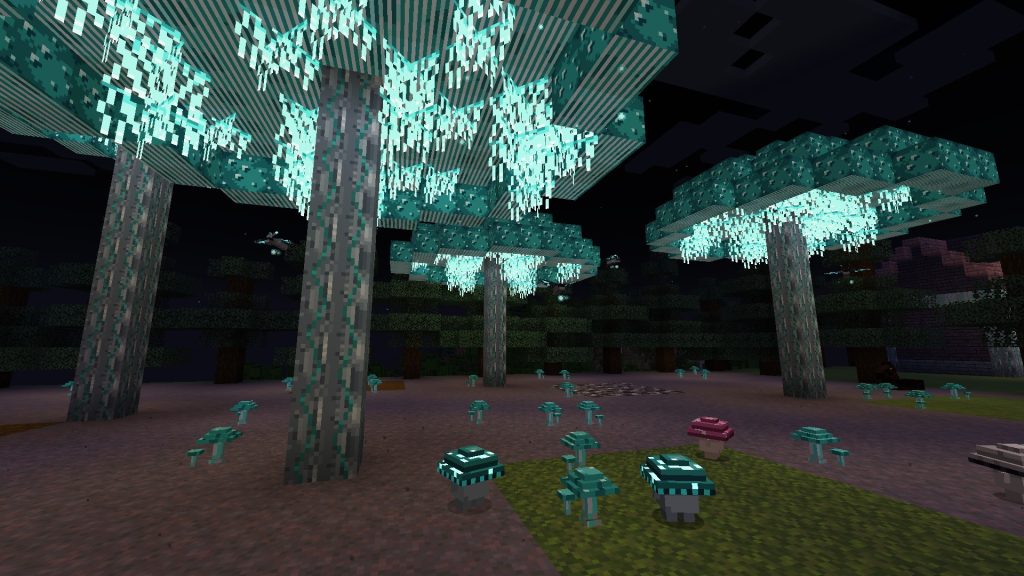
Spore & Stem connects exploration, building, mushroom cultivation and combat. Fungal content appears throughout the existing Minecraft world, including luminous mushrooms, building blocks, farming equipment and creatures. It adds no new biomes: features are distributed through existing biomes using tags.
This guide covers release 2.0.0. Gameplay details come from the author’s materials, while download compatibility comes from individual release files. The project-wide list of older supported Minecraft versions must not be applied wholesale to this release.
Three giant mushrooms: locations and cultivation
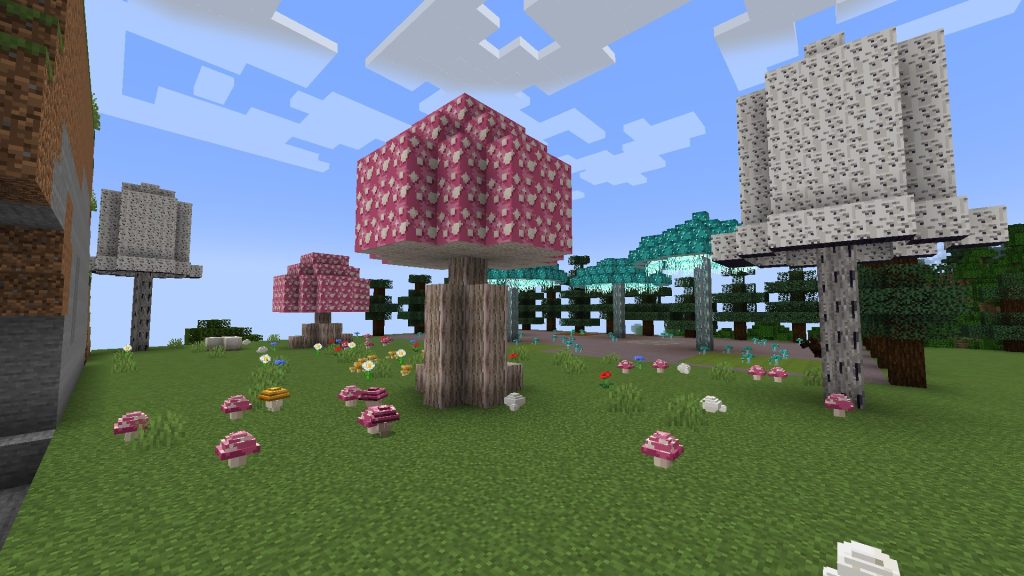
Glowcap, Bouncecap and Inkcap have different appearances, habitats and properties. All three occur in Mushroom Fields, with additional habitats elsewhere.
- Bone meal can grow a giant from its corresponding small mushroom.
- Suitable ground includes dirt, moss, mycelium and Mycelial Soil; enough free space is required.
| Species | Where it grows | Properties |
|---|---|---|
| Huge Glowcap | Mushroom Fields and deep cave floors. | Glowing cap and hanging gill curtains, light level 14. |
| Huge Bouncecap | Flower forests, meadows and Mushroom Fields. | Its springy cap bounces a landing player without fall damage. |
| Huge Inkcap | Dark forests, swamps and Mushroom Fields. | A tall mushroom with a shaggy bell-shaped cap that drips ink. |
Fungal wood and building materials
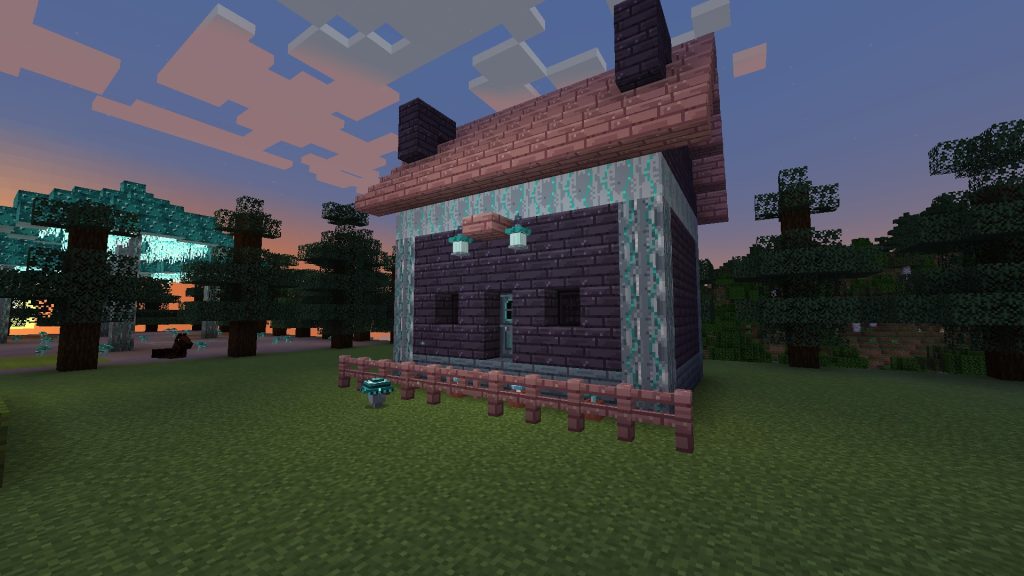
Each giant supplies a separate building set. Glowcap wood is cool blue-grey with teal grain; Bouncecap is rosy tan; Inkcap is dark charcoal violet. Doors and trapdoors carry the corresponding species’ visual motif.
Each set includes stems, stripped stems, hyphae, stripped hyphae, planks, stairs, slabs, fences, gates, doors, trapdoors, buttons and pressure plates, plus cap blocks. Axes strip the stems. The materials work in recipes accepting suitable logs or planks, including sticks, chests and crafting tables.
The wood does not catch fire but can still fuel a furnace: these are separate properties. Glowcap Lantern has light level 15 and can stand or hang. It uses Glowcap stems, Lumen Spores and Mycelial Thread.
Nine small mushrooms: effects and habitats
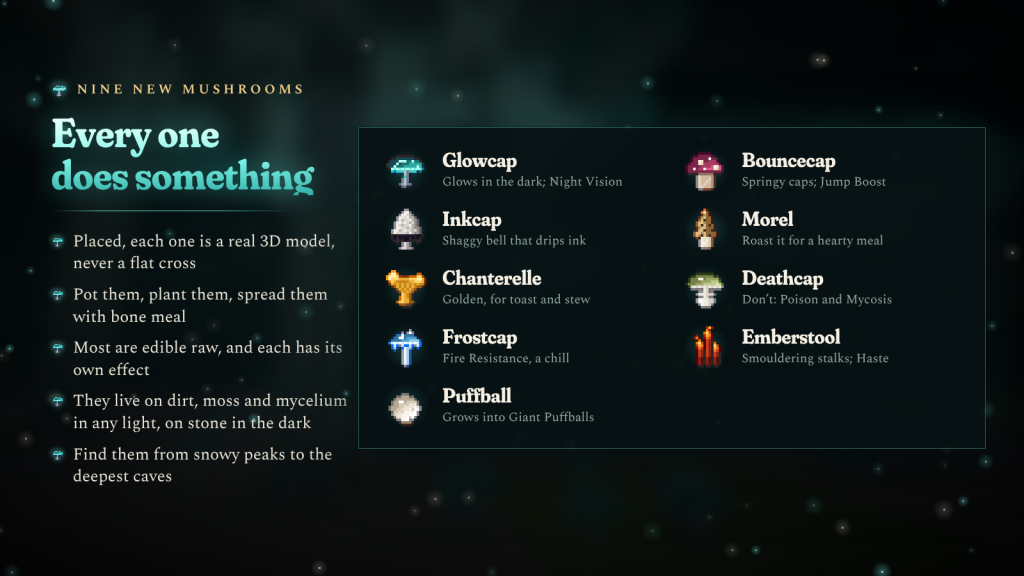
Small mushrooms use three-dimensional models. Their placed rotation and position vary slightly, and all nine fit in flower pots. Some species are inedible or have harmful effects.
- Mushrooms live on dirt, moss, mycelium and Mycelial Soil at any light level, or on other solid blocks in the dark.
- Bone meal spreads small mushrooms to a free nearby position.
| Mushroom | Effect or use | Habitat |
|---|---|---|
| Glowcap | Night Vision for 10 seconds; placed light level 9. | Mushroom Fields, dark forests, caves. |
| Bouncecap | Jump Boost for 10 seconds. | Flower forests, meadows, birch forests. |
| Inkcap | Inedible; crafts black dye. | Swamps, dark forests, old growth taiga. |
| Morel | Restores 2 hunger points raw or 6 when roasted. | Forests and birch forests. |
| Chanterelle | Restores 2 hunger points. | Taiga and birch forests. |
| Deathcap | Causes Poison II and Mycosis. | Dark forests. |
| Frostcap | Fire Resistance for 10 seconds with brief Slowness. | Snowy biomes. |
| Emberstool | Haste for 10 seconds; placed light level 7. | Deep caves, crimson forests, basalt deltas. |
| Puffball | Restores 2 hunger points; nine craft a Giant Puffball. | Plains, meadows, savanna. |
Other fungal features in the world
Mushroom Fields and caves gain additional growths. Some provide materials, while others can be climbed or interact with falling.
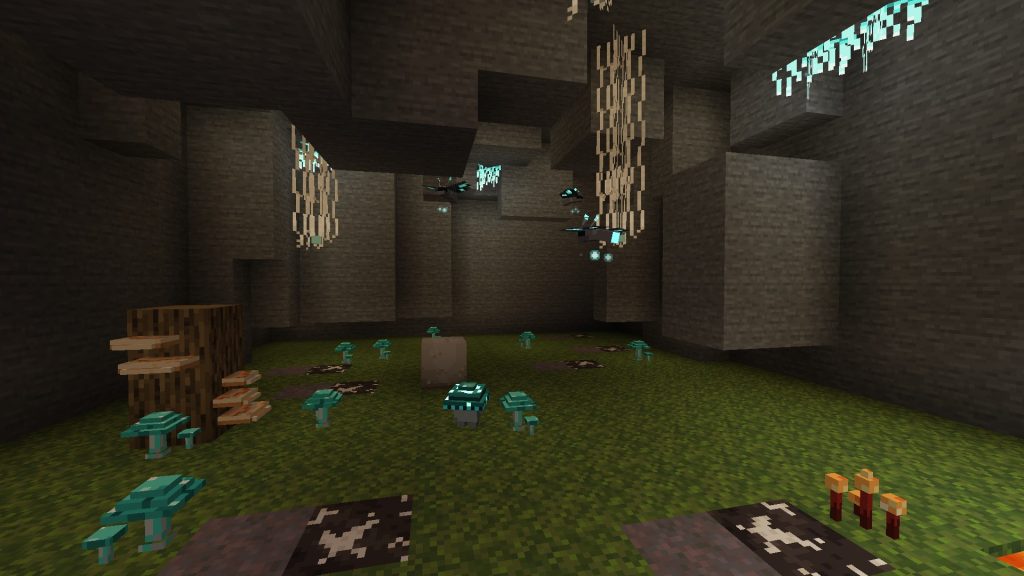
- Mycelial Veils hang from cave ceilings and grow downward. They are climbable. Glowing bulbs have light level 10 and provide Lumen Spores; shears or a Foraging Knife gather Mycelial Thread.
- Shelf Fungus grows on trunks as one to three shelves. The shelves grow over time and are solid enough to use as steps.
- Glowcap Gills hang beneath giant Glowcaps and provide Lumen Spores.
- Giant Puffballs release spores when landed on and halve fall damage.
- Fairy Rings occur in plains and forests at the author’s stated rate of one in 48 chunks. Truffle Soil appears under forests. Natural features generate in newly generated chunks.
Cultivation Logs, Mycelial Soil and the Foraging Knife
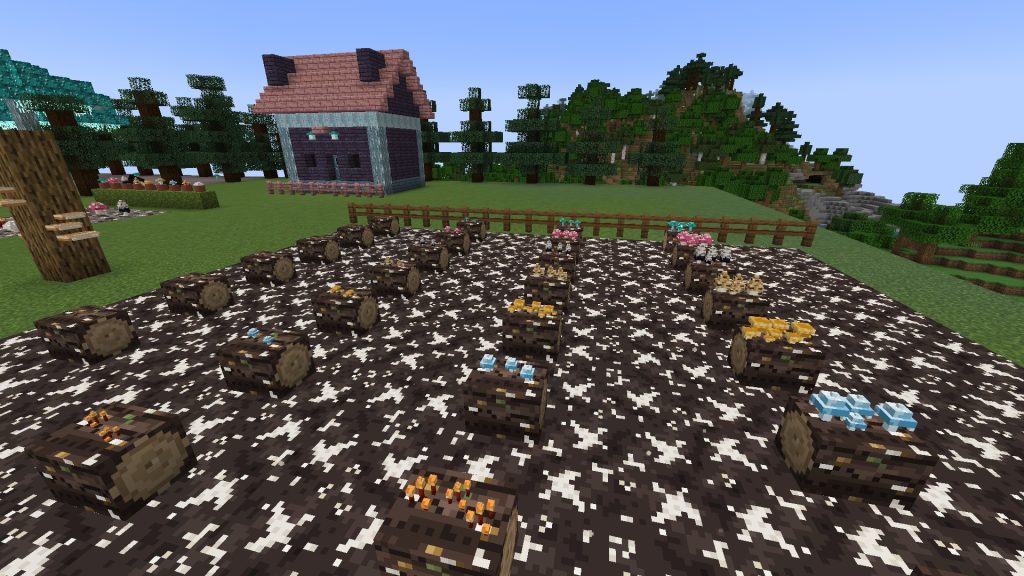
Cultivation Logs turn gathering into a repeating farming cycle. Glowcap, Bouncecap, Inkcap, Morel, Chanterelle, Frostcap and Emberstool can inoculate a log. Deathcap and Puffball are not listed as suitable cultures.
- Three logs, two Mycelial Thread and one Mycelial Soil craft two Cultivation Logs. Inoculate a fresh log with a suitable mushroom; it develops through four stages.
- Use a ripe log to collect 2–3 mushrooms. Another fruiting cycle follows the harvest.
- Logs fruit twice as fast on Mycelial Soil and more slowly under an open daytime sky.
- Dirt, bone meal and any two mushrooms craft two Mycelial Soil blocks. Mushrooms, including vanilla species, live on this soil at any light level.
- Iron, a stick and Mycelial Thread craft the Foraging Knife. It mines fungal blocks quickly, improves spore, gel and ink yields, and cuts thread from veils.
The mushroom kitchen: ingredients and effects
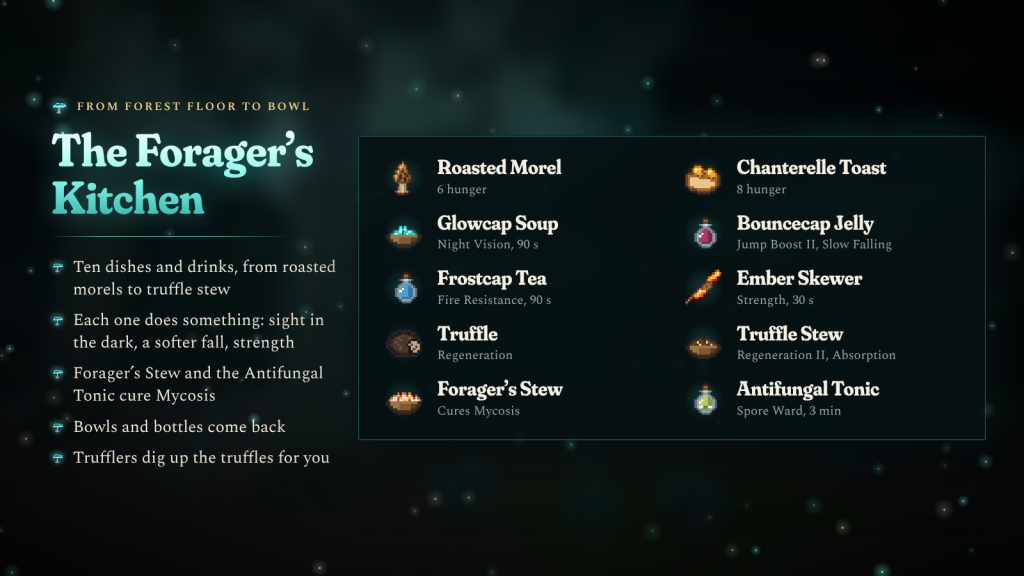
The mod includes ten foods and drinks. Choose a recipe by its intended result as well as available ingredients. Values below are reported by the author rather than independently measured.
- The relevant bowls and bottles are returned after consumption.
| Food or drink | Ingredients / preparation | Result |
|---|---|---|
| Roasted Morel | Cook a Morel in a furnace, smoker or campfire. | 6 hunger points. |
| Chanterelle Toast | Bread and 2 Chanterelles. | 8 hunger points. |
| Glowcap Soup | Bowl, 2 Glowcaps and Lumen Spores. | Night Vision for 90 seconds. |
| Bouncecap Jelly | Glass bottle, Bouncecap Gel and sugar. | Jump Boost II for 45 seconds; Slow Falling for 15 seconds. |
| Frostcap Tea | Glass bottle, 2 Frostcaps and sugar. | Fire Resistance for 90 seconds. |
| Ember Skewer | Stick, Emberstool and Roasted Morel. | Strength for 30 seconds. |
| Truffle | Obtained through Truffle Soil and Trufflers. | Regeneration for 5 seconds. |
| Truffle Stew | Bowl, Truffle, Morel, Chanterelle and baked potato. | Regeneration II for 8 seconds; Absorption for 60 seconds. |
| Forager’s Stew | Bowl and any 3 edible mushrooms. | Cures Mycosis. |
| Antifungal Tonic | Glass bottle, Frostcap, Chanterelle and honey bottle. | Cures Mycosis; Spore Ward for 3 minutes. |
Mycosis: infection, treatment and immunity
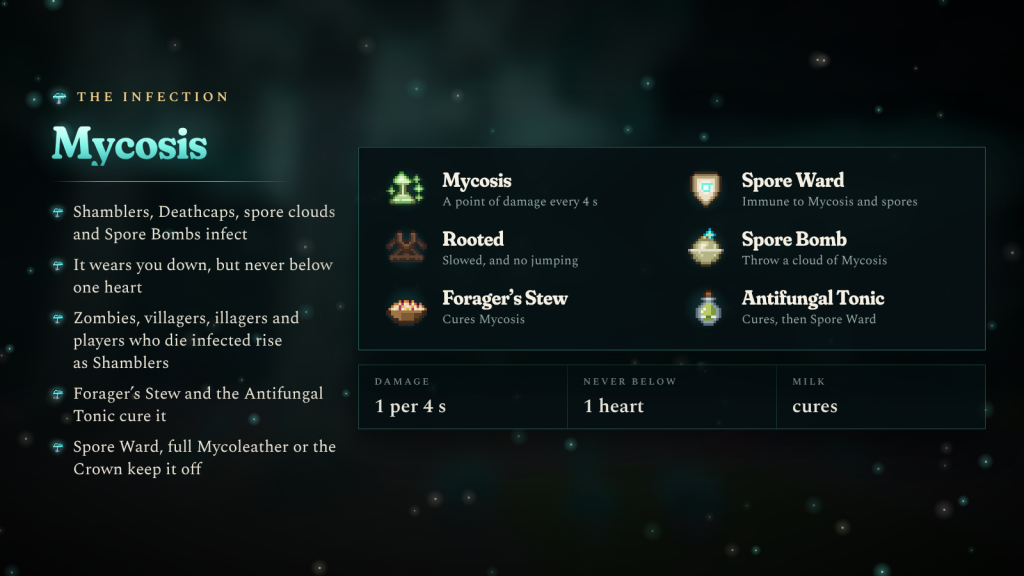
Mycosis can come from Shambler hits, Deathcaps, spore clouds, Spore Globs and Spore Bombs. At its first level it deals one damage every four seconds; each additional level doubles the frequency. The infection itself never reduces health below one heart.
Infected deaths are another danger. Zombies, husks, drowned, villagers, pillagers, vindicators, witches and players that die with Mycosis can rise as Shamblers. Fungal creatures are immune.
- Cures: milk, Forager’s Stew or Antifungal Tonic.
- Spore Ward protection comes from the tonic, a full Mycoleather set or the Crown of the Bloom.
- A Puffball, Deathcap and Mycelial Thread craft two Spore Bombs. Throwing one creates a Mycosis and Slowness cloud.
- The infection and the rising of infected dead can be configured separately.
Friendly creatures: taming and useful resources
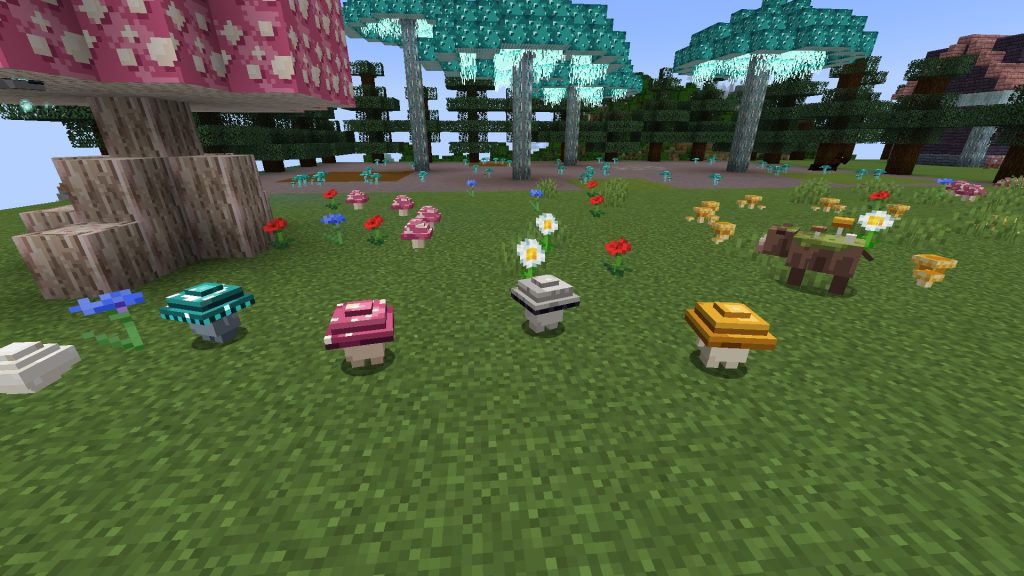
Sporelings, Trufflers and Glowmoths have separate roles. They should be distinguished from the four hostile species and the separate boss.
| Creature | Behavior | Interaction |
|---|---|---|
| Sporeling | One of four biome-dependent caps; tends nearby fungi. | Truffles tame it with a one-in-three chance. Tamed Sporelings follow, sit when used and shed a mushroom of their type every 5–10 minutes. Truffles are also used for breeding. |
| Truffler | A mossy boar that sometimes digs up truffles and locates nearby Truffle Soil. | Breed using truffles. |
| Glowmoth | A luminous moth attracted to light and Glowcaps. | Provides Lumen Spores. |
Hostile creatures: recognizing the threats
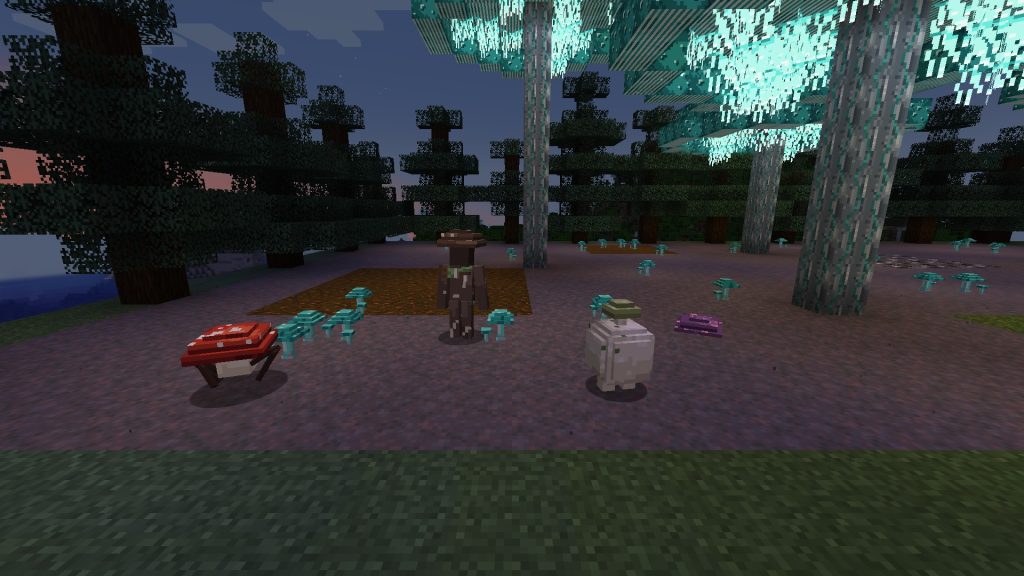
Each opponent has distinct mechanics. A shared fungal appearance does not mean shared behavior. Health values below use Minecraft health points.
| Creature | Health | Behavior |
|---|---|---|
| Bloatshroom | 16 | Approaches, swells and releases spores causing Mycosis, Nausea and Blindness. Breaks no blocks; fire triggers it. |
| Shambler | 26 | Hits infect. It does not burn, but wilts in full sunlight. |
| Sporemaw | 20 | Waits buried with its cap exposed, emerges and throws Spore Globs. Burrows again after taking three hits. |
| Mimicap | 22 | Disguises itself as a red or brown mushroom. Unfolds within five blocks, walks on six legs, climbs walls and applies Rooted with bites. |
Summoning Myceliarch and preparing for the encounter
Summon the boss with a Fruiting Heart crafted from 4 Lumen Spores, 2 Truffles, 2 Mycoleather and a Mycelial Core. Cores come from Shamblers, Mimicaps or Sporemaws. The author’s FAQ lists base drop chances of 5%, 8% and 4% respectively, increased by Looting.
Use the Fruiting Heart on mycelium, Mycelial Soil, podzol or moss. Roots and spores appear for three seconds before the boss rises with a separate health bar. Only one may exist at a time within 96 blocks.
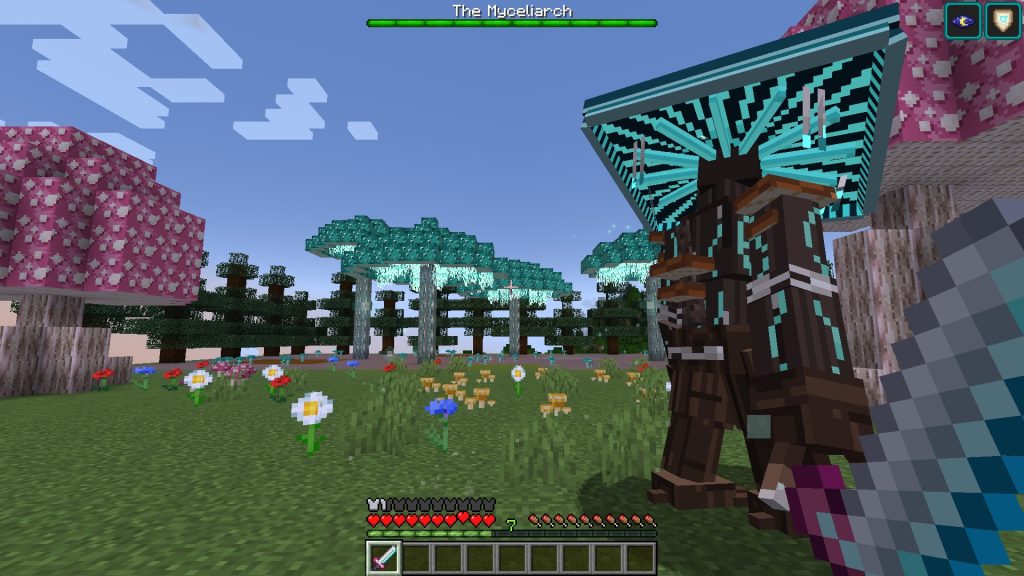
Myceliarch has 300 health and 10 armor. It does not despawn, cannot be pushed, breaks no blocks and stays within 40 blocks of its emergence point. Its attacks have visible warning cues worth watching.
Myceliarch attacks and second phase
At half of the boss’s own health, it enters a second phase, moving faster, attacking more often and adding Spore Rain. The trigger is not the player’s health.
| Attack | What happens |
|---|---|
| Slam | A frontal strike deals 14 damage with a ring of Root Spikes. Ground spores mark the landing location first. |
| Root Eruption | A ground crack is followed by a line of twelve Root Spikes, each dealing 8 damage and Rooted. |
| Spore Nova | An expanding Mycosis II spore ring reaches seven blocks and knocks targets back. |
| Brood Call | Summons two Bloatshrooms and one Shambler. |
| Spore Rain | Second-phase globs fall around the player, with marked landing spots. |
Boss rewards, weapons and fungal armor
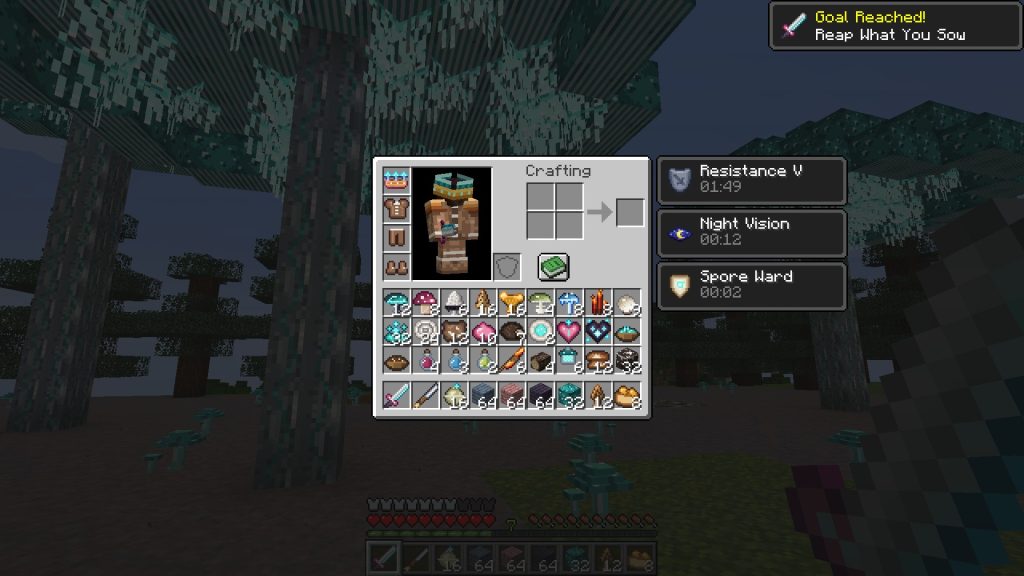
Defeating Myceliarch rewards a Spore Heart, 4–8 Mycoleather, 8–16 Lumen Spores and 250 experience. The heart is used in special equipment.
| Item | Crafting | Properties |
|---|---|---|
| Bloomreaver | Spore Heart, diamond sword, 2 Lumen Spores and 2 Mycoleather. | 8 attack damage; hits infect. Active Spore Burst applies Mycosis and Slowness nearby with knockback; 10-second cooldown. |
| Crown of the Bloom | Spore Heart, golden helmet and 2 Glowcap Caps. | Night Vision and Spore Ward while worn; Sporelings trust the wearer. |
| Mycoleather | 3 mushroom caps and Mycelial Thread make 2 materials. | Armor between leather and iron; a full set grants Spore Ward. |
Configuration and additional features
The file config/spore_and_stem.json is created after the first launch. The author states that keys have comments, missing keys are added and existing values are retained.
- mycosis_enabled toggles infection, mycosis_rising controls infected deaths, and mycosis_damage_interval sets the damage interval.
- myceliarch_health and myceliarch_damage_multiplier configure boss health and damage.
- sporeling_shed_min and sporeling_shed_max set mushroom-shedding intervals in minutes; truffler_dig_chance controls digging chance.
- The mod lists 15 advancements and 55 subtitled sounds, with its own creative inventory tab.
- Biome tags control natural features and spawns and can be changed by a datapack. Mushrooms, caps and puffballs can be composted.
Minecraft versions, dependencies and installation
The following combinations are confirmed by release 2.0.0 file metadata. The author’s description contains a separate 1.21.1 compatibility table; 1.20.1 files are additionally confirmed by release records. Do not select a loader from the project-wide compatibility list alone.
- Choose the Minecraft profile and matching loader. For 1.21.1, the author specifies Java 21+.
- Download the matching game-version and loader file and follow the author’s installation instructions. Add Fabric API for Fabric.
- For multiplayer, the author specifies the same mod version on the server and every client.
- Spore & Stem is a mod, not a Paper, Spigot or Folia plugin. Individual files are listed in the downloads section below.
| Minecraft | Loader | Dependencies in metadata |
|---|---|---|
| 1.20.1 | Fabric | Fabric API is required. |
| 1.20.1 | Forge | No additional dependencies listed. |
| 1.21.1 | Fabric | Fabric API is required. |
| 1.21.1 | NeoForge | No additional dependencies listed. |
Frequently asked questions
These answers follow the author’s FAQ and release information.
- Is a new world required? The author allows installation in existing worlds, with natural features in new chunks. Upgrading from the former Genetically Modified Monsters is a separate case; the identifier-change warning is at the beginning of this article.
- Where are the giants? All three occur in Mushroom Fields. Glowcaps also grow in caves, Bouncecaps in flower forests and meadows, and Inkcaps in dark forests and swamps.
- How do I remove Mycosis? Use milk, Forager’s Stew or Antifungal Tonic. Spore Ward protects against infection, and the mechanic can be disabled in configuration.
- Can a Bloatshroom destroy my house? The author says it releases spores without breaking blocks. Myceliarch also breaks no blocks.
 How to install
54645654